All the news
I think I’ve mentioned here before that my main diet of news comes from a collection of RSS feeds, somewhere around 150 as of this morning. The news feeds cover a variety of subjects - Church and religious news, local current events, technology, and so on. But, frankly, it was getting to be too much. Dropping it completely doesn’t seem like a good option, and neither does paring my information diet down to a very few sources seem wise. In the current moment, it seems very important to draw from as many sources as possible, which produces the very tension that I’m trying to solve.
So, of course, the answer was to sic an AI on it.
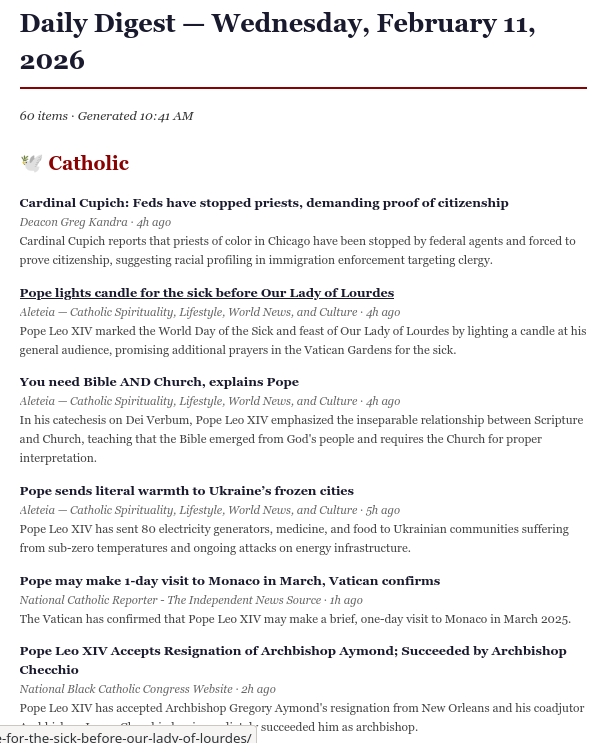
Someone had recently written (probably on HN) that they had tasked an LLM to parse a tremendous amount of news, filter it for redundancy, rank it according to taste, and summarize it. This sounded like a nifty idea, so I put Claude to work on the code. It only took a few minutes for the first iteration, and it worked pretty well. I sprang for $5 worth of API credits, because part of this script sends the raw news back to Claude for summarization, and you pay a bit extra for that. I spent several iterations this morning, having the code tweaked and a mail-this-to-me-daily function added. The total cost so far is around 32 cents. The end products are a basic config file, a reasonably-sized python script which does the heavy lifting, and a list of the feeds I want it to skim and summarize. The only real lift on my end was a bit of msmtp configuration for the email part and the purchase of the API key.
It works really well. I can now retire elfeed from my emacs workflow and peruse my digest on the phone wherever I am. It works so well that I added a few more local news sources to better cover Shelbyville and Bedford County, plus some more national-level wire services. I can see continuing to add feeds as well as adjusting the max items per category, but that’s about it.
Frankly, the weirdest thing was reading the prompt that it uses…to talk to itself about me:
You are generating a daily news digest for a Catholic deacon with an MA in Theology. He reads widely across Catholic thought, culture, politics, and technology…Be concise and substantive — he reads a lot and values density over
padding.
For local news items mentioning Murfreesboro, Rutherford County, Shelbyville, or Bedford County, note the local relevance explicitly.
For items originally in Spanish, provide the summary first in Spanish, then an English translation on the next line, formatted as: “Spanish summary // EN: English summary”
It ‘knows’ these things because I added them to my basic prompt, establishing a sort of baseline for the sorts of responses I expect to get back and saving me from having to repeat them every single time I ask a question:
I am an ordained Catholic Deacon with an MA in Theology. Answers should be tuned accordingly towards greater theological depth. Include relevant citations of magisterial documents, (eg. CCC, CIC, or scripture) as needed. If scripture is quoted, include the biblical translation and try to favor the Catholic edition of the RSV. I have a working knowledge of Koine Greek and ecclesial Latin; these are also acceptable in responses. Denzinger references are also acceptable.
If any other books are mentioned in responses, their existence should be confirmed via ISBN searches before including them. Likewise, articles should be checked for DOI numbers before answering. Do not end responses with additional conversational-type open-ended questions unless required for clarification.
It’s still very weird to see it show up in code, especially the bit about ‘be concise and substantive.’
Here’s what the final product looks like: