
Sunny window nap

Sunny window nap
From The Sign of Jonas, a diary Thomas Merton kept during the first few years after making his perpetual vows at Gethsemani:
The way You have laid open before me is an easy way, compared with the hard way of my own will which leads back to Egypt, and to bricks without straw.
If You allow people to praise me, I shall not worry. If You let them blame me, I shall worry even less, but be glad. If You send me work I shall embrace it with joy and it will be rest to me, because it is Your will. And if You send me rest, I will rest in You. Only save me from myself. Save me from my own, private, poisonous urge to change everything, to act without reason, to move for movement's sake, to unsettle everything You have ordained.
Let me rest in Your will and be silent. Than the light of Your joy will warm my life. Its fire will burn in my heart and shine for Your glory. This is what I love for. Amen, amen.
I want to write about Steindl-Rast's Gratefulness but I'm not sure if I'm up to it. Pieces of it come back to me constantly which I take to be a good sign. It has opened doors to contemplative forms of prayer which were sort of on the periphery, just out of the corner of my eye. Close-by, but un-named and maybe unseen. Then you see them and the reaction is "Of course! It was there all along!" It seems strange that such a short book would be difficult to summarize, so universal as to defy simple categorization. It is, in short, a book about prayer and gratitude, and how each reflects and magnifies the other in the smallest of moments. These moments should catch us by surprise, which means we must - paradoxically - be prepared for surprise.
That will have to suffice for now. Maybe more later.

Currently reading: Compensating the Sales Force, Third Edition: A Practical Guide to Designing Winning Sales Reward Programs by Cichelli, David 📚
Here is a very rare post that touches ever-so-briefly on work.
I don’t do a ton of business-related reading. When I do, it’s usually because some book is making the rounds in the C-suite of my employer and reading what they’re reading has been helpful in my role, which is nominally manager but perhaps more accurately described as contextualizer-in-chief.
In any event, the start of a new fiscal year comes with the annual adjustments to the sales compensation plan (i.e., quotas, bonuses, spiffs, and the like). These might seem like a minor thing to the rest of the company but I’m here to tell you that they are of nearly existential importance to the sales team, of which I am a part.
I recently got very interested in how compensation plans are developed, so here we are.
Still working through David Steindl-Rast's book on gratitude and prayer. I'll have more to write when I'm done. It's been wonderful so far. He frequently quotes Rainer Maria Rilke, who has been on my radar for some time now. I ordered a collection of Rilke's poetry which was delivered earlier today. Then I'll maybe alternate that with Merton's The Sign of Jonas.
Hopefully Rilke and Merton will serve to more than offset some work-related reading that's coming my way on the design of sales compensation plans.

Currently reading: Gratefulness, The Heart of Prayer: An Approach to Life in Fullness by Steindl-Rast, David 📚
This was just recently recommended to me, along with Thomas Merton’s The Sign of Jonas, by a deacon with whom I met recently as part of the discernment/application process. He also recommended deeper/further exploration of contemplative prayer, so I’ve begun regular lectio again.
I’ve tried lectio on and off over the years but after our conversation on prayers and praying, I’m really going to try to make it stick this time. Attempting to turn the Office into lectio hasn’t really worked either. I think this is fine; he helped me to reframe some of my thinking around the Office as well.
Timothy Keller, writing in the NYT a few weeks ago:
So Christians are pushed toward two main options. One is to withdraw and try to be apolitical. The second is to assimilate and fully adopt one party’s whole package in order to have your place at the table. Neither of these options is valid. In the Good Samaritan parable told in the Gospel of Luke, Jesus points us to a man risking his life to give material help to someone of a different race and religion. Jesus forbids us to withhold help from our neighbors, and this will inevitably require that we participate in political processes. If we experience exclusion and even persecution for doing so, we are assured that God is with us (Matthew 5:10-11) and that some will still see our “good deeds and glorify God” (1 Peter 2:11-12). If we are only offensive or only attractive to the world and not both, we can be sure we are failing to live as we ought.
David French referred to this piece in his newsletter this morning. I recommend reading both in their entirety.
Low blow, Amazon. Low blow. Holiday wishbook? Chock full of toys?

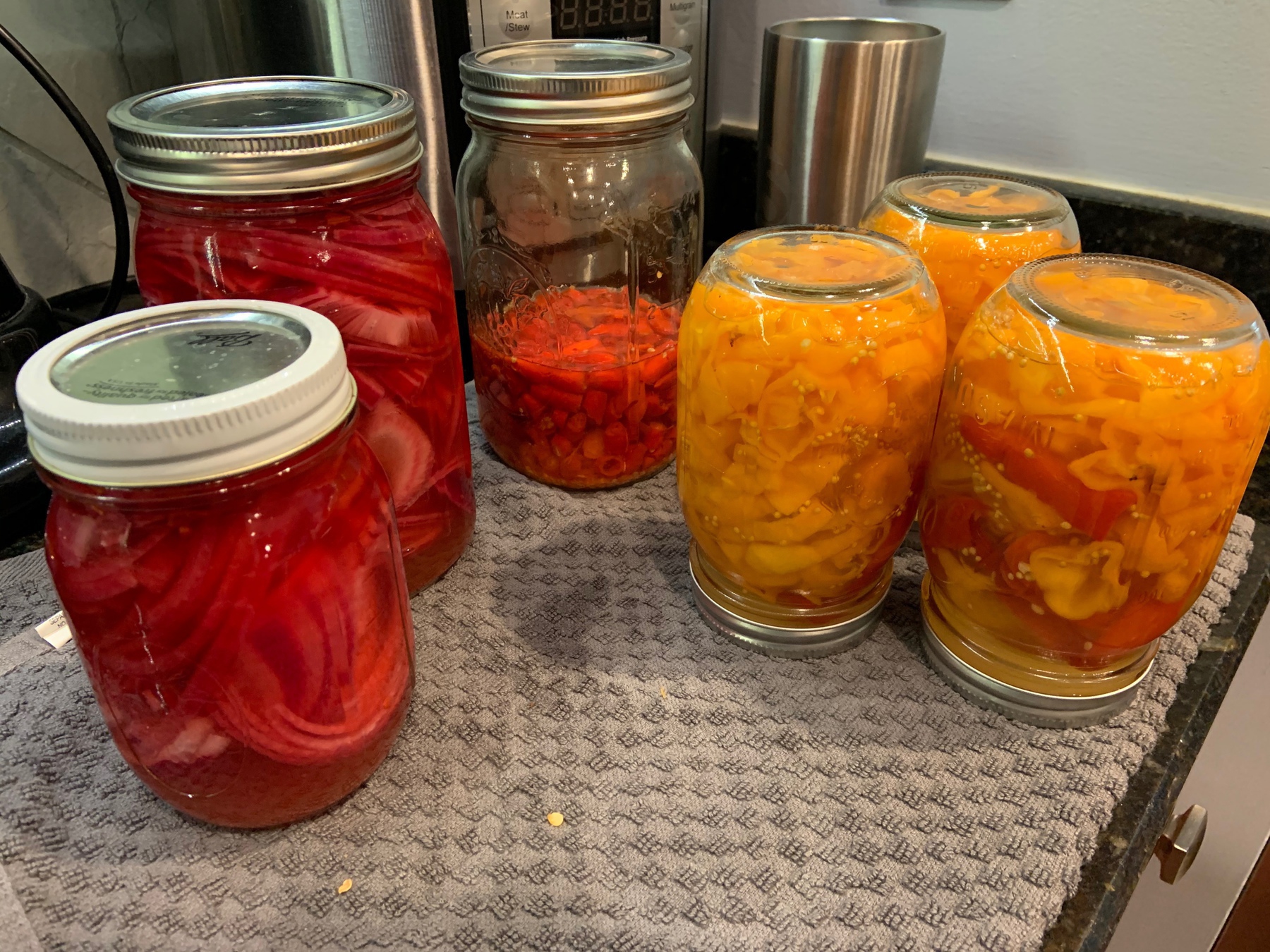
Pickling and fermenting
No. 70, from an extended meditation on the parable of The Good Samaritan, the Holy Father writes:
It is remarkable how the various characters in the story change, once confronted by the painful sight of the poor man on the roadside. The distinctions between Judean and Samaritan, priest and merchant, fade into insignificance. Now there are only two kinds of people: those who care for someone who is hurting and those who pass by; those who bend down to help and those who look the other way and hurry off. Here, all our distinctions, labels and masks fall away: it is the moment of truth. Will we bend down to touch and heal the wounds of others? Will we bend down and help another to get up? This is today’s challenge, and we should not be afraid to face it. In moments of crisis, decisions become urgent. It could be said that, here and now, anyone who is neither a robber nor a passer-by is either injured himself or bearing an injured person on his shoulders.