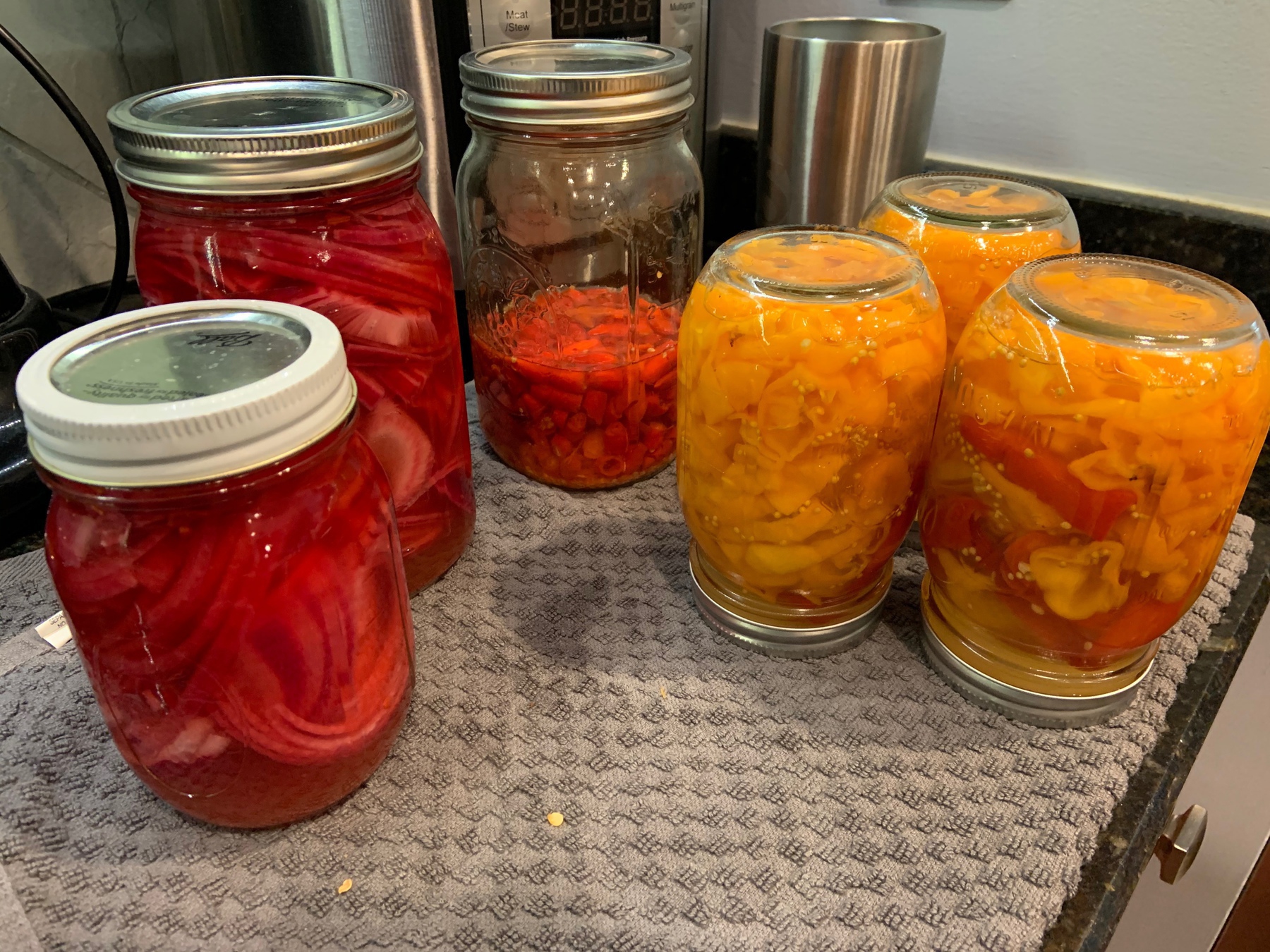
Pickling and fermenting
No. 70, from an extended meditation on the parable of The Good Samaritan, the Holy Father writes:
It is remarkable how the various characters in the story change, once confronted by the painful sight of the poor man on the roadside. The distinctions between Judean and Samaritan, priest and merchant, fade into insignificance. Now there are only two kinds of people: those who care for someone who is hurting and those who pass by; those who bend down to help and those who look the other way and hurry off. Here, all our distinctions, labels and masks fall away: it is the moment of truth. Will we bend down to touch and heal the wounds of others? Will we bend down and help another to get up? This is today’s challenge, and we should not be afraid to face it. In moments of crisis, decisions become urgent. It could be said that, here and now, anyone who is neither a robber nor a passer-by is either injured himself or bearing an injured person on his shoulders.
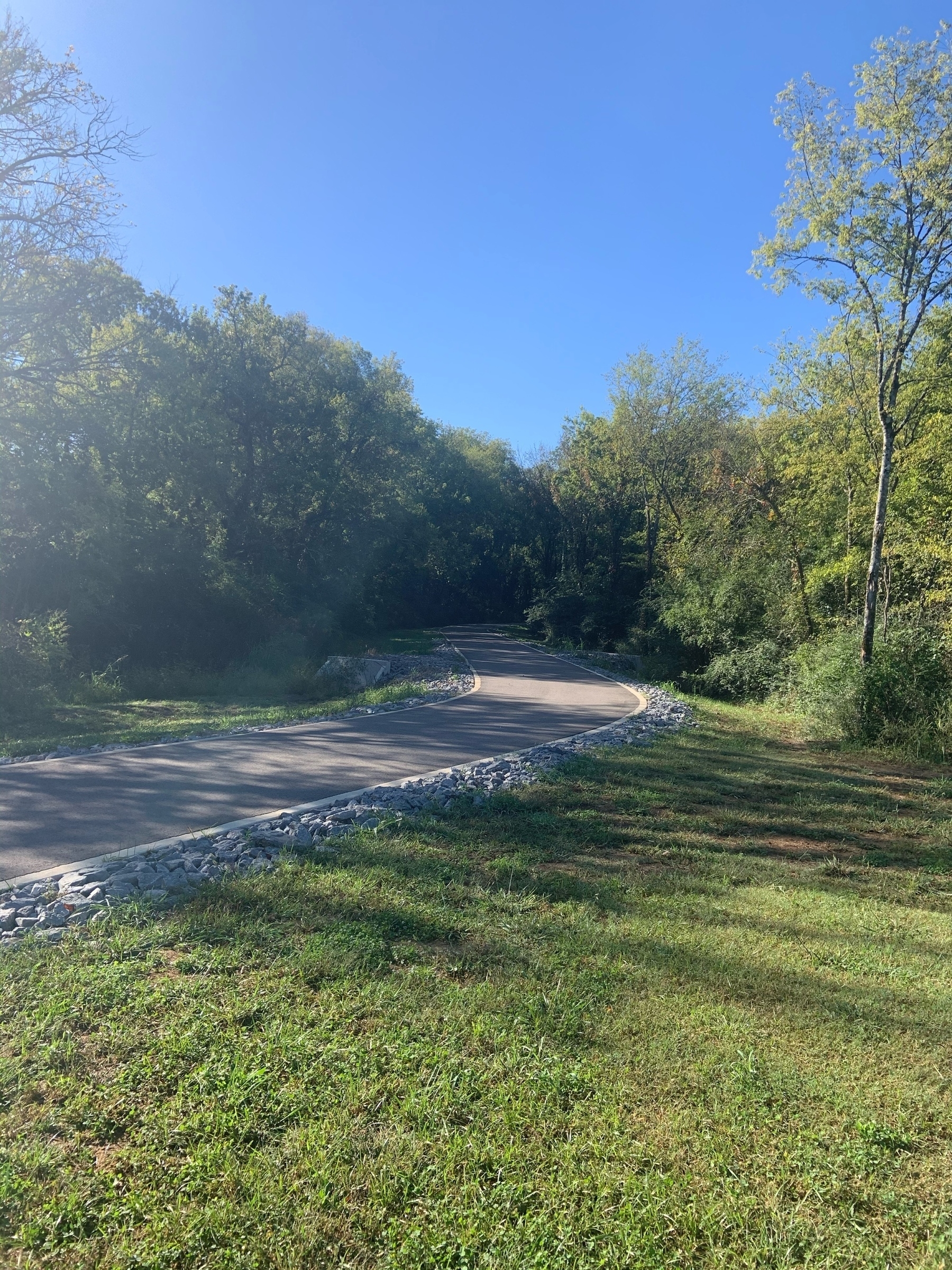
Running haunt
Abba Joseph on friendship, and in particular, the “silent treatment” in the Sixteenth Conference:
But what sort of thing is it that we sometimes think that we are patient because, when we are aroused, we disdain to respond but mock our irritated brothers by a bitter silence or by a derisory movement or gesture in such a way that we provoke them to anger more by our taciturn behavior than we would have been able to incite them by passionate abuse, in this respect considering ourselves utterly blameless before God, since we have voiced nothing that could brand or condemn us according to the judgement of human beings? As if it were words alone and not the will in particular that is declared guilty in the sight of God, and just the sinful deed and not also the wish and the intention that should be considered wrong, and only what each person has done and not also what he wanted to do that should be submitted to judgement.
[…]
It is of no value not to speak, then, if we enjoin silence on ourselves in order to do by silence what would have been done by an outcry…
N.B.: this post contains nothing but amateur radio nerding, so consider yourself forewarned.
This past weekend was the CQ WW RTTY DX contest, which is one of the few contests that I try to do every year. I don't take it terribly seriously - if I can make 100 or so contacts over the course of a casual weekend's worth of operating, I'll take them. I enjoy working RTTY, and the big contests are about the only time I get a chance.
In any case, this was the first contest I was able to use the RSPDx as a pandapter for the FT-450D and it worked a treat. Seriously, seeing all of a band at once was something else, especially with all of the stations up and running all weekend. It looked like the matrix or something. Since I run an all-Linux shack, I spent a bit of time tinkering with various CAT setups until I landed on a good rigctld config that let gqrx and the transceiver steer each other, though I did need a little python widget for gqrx to complete the setup. I let fldigi log to CQRLOG for LoTW and eQSL, but will use fllog's data to submit the Cabrillo file for scoring. Everything ran great. As lovely as CubicSDR is, all I needed was basic visualization, and gqrx picked up the SDRPlay soapysdr libraries just fine.
In any event, band conditions were wonky thanks to a big solar storm that hit us over the weekend, which made for some nice aurora photos but played havoc with HF propagation. Most of my contacts were domestic, but I managed a few good DX contacts: South America, Europe, and getting Hawaii is always fun. I strictly search-and-pounce; maybe next contest I'll try to run if I can find a spot. Getting everything wired together and working well was the main goal this weekend, so mission accomplished.
O God, come to my assistance. O Lord, make haste to help me.
Every hour of the Divine Office begins with this verse from Psalm 69. It's safe to say that we have St. Benedict to thank for that - Chapter 18 of the Rule lays out the plan for monastic Psalmody and it leads right off with these words:
Each of the day hours begins with the verse, God, come to my assistance; Lord, make haste to help me. (Ps 69[70]:2), followed by "Glory be to the Father" and the appropriate hymn.
So it was a thousand years ago and so it is to this day. But why? We have to look back at Cassian again. In the tenth Conference, On Prayer, Abba Isaac concludes his two-part lesson by proposing a 'formula' for cultivating an perpetual awareness of God. This verse, he explains, contains all that is absolutely necessary:
Not without reason has this verse been selected from out of the whole body of Scripture. For it takes up all the emotions that can be applied to human nature and with great correctness and accuracy it adjusts itself to every condition and every attack. It contains an invocation of God in the face of any crisis, the humility of a devout confession, the watchfulness of concern and constant fear, a consciousness of one's own frailty, the assurance of being heard, and confidence in a protection that is always present and at hand, for whoever calls unceasingly on his protector is sure that he is always present. It contains a burning love and charity, an awareness of traps, and a fear of enemies. Seeing oneself surrounded by day and night, one confesses that one cannot be set free without the help of one's defender. This verse is an unassailable wall, an impenetrable breastplate, and a very strong shield for all those who labor under the attack of demons. It does not permit those troubled by acedia and anxiety of mind or those depressed by sadness or different kinds of thoughts to despair of a saving remedy, showing that he whom it invokes is always looking upon our struggles and is not detached from his suppliants. It warns those of us who are enjoying spiritual successes and are glad of heart that we must never be exalted or puffed up because of our good fortune, which it testifies cannot be maintained without the protection of God, for it begs him to come to our aid not only at all times but also quickly.
Abba Isaac beautifully explains why these words answer to all parts of the human condition, concluding with the exhortation to:
Let sleep overtake you as you meditate upon this verse until you are formed by having used it ceaselessly and are in the habit of repeating it even while asleep. Let this be the first thing that comes to you when you awake, let it anticipate every other thought as you get up, let it send you to your knees as you arise from your bed, let it bring you from there to every work and activity, and let it accompany you at all times.
It's such a short phrase; we may be tempted to pass right over it rather mechanically as we begin our prayer. It seems well worth lingering over in the moments between prayer, in times of difficulty or joy, frustration or elation, for it simultaneously acknowledges our dependence on God and our confidence in His love and boundless mercy. These aren't "magic words" - they're the cry from a child's heart to a loving parent! In them, we express our surrender and deepest desire: Come, Lord Jesus!
The full trailer for Dune has finally dropped.
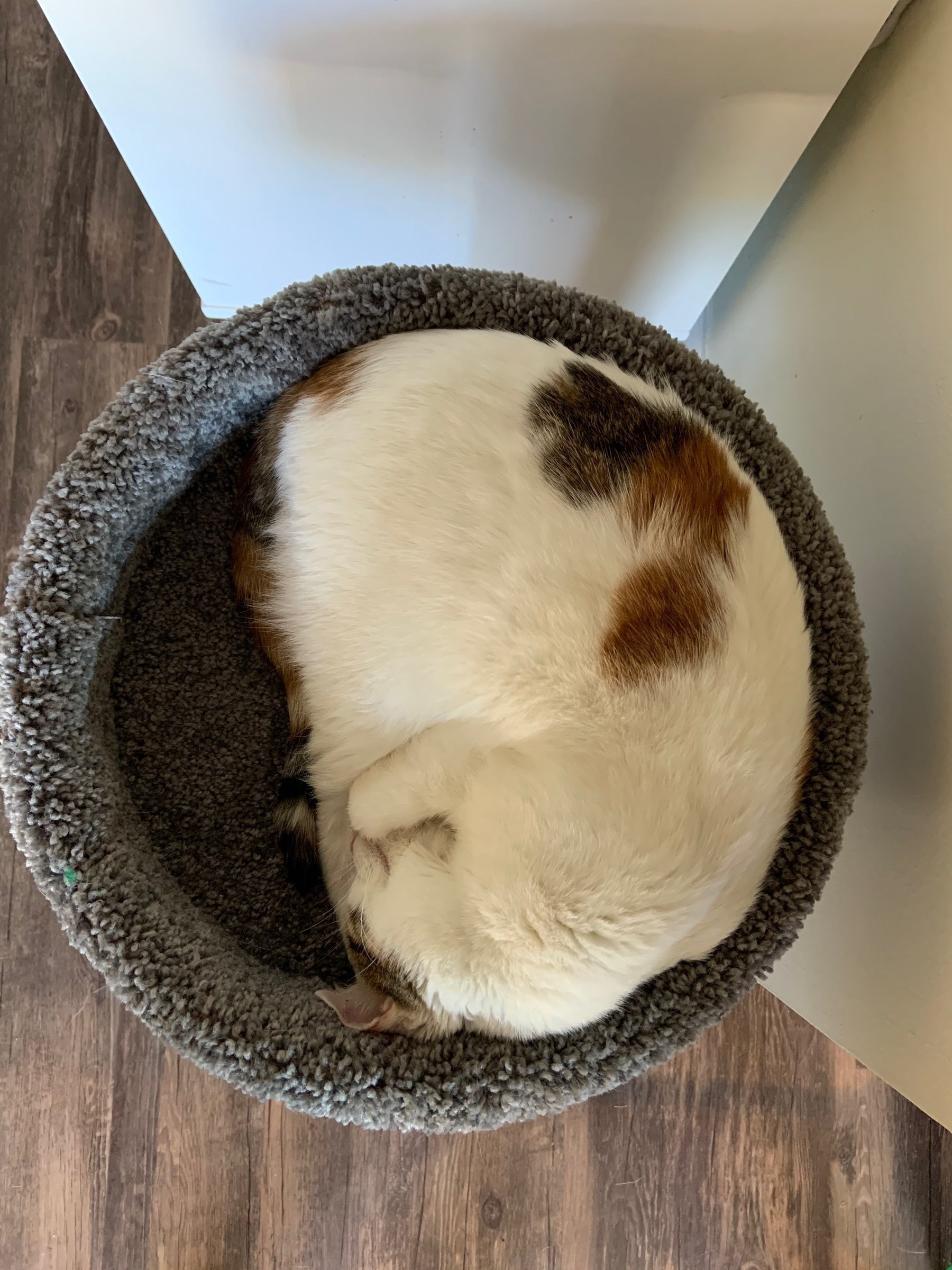
Waxing gibbous cat
Two briskets rubbed down and ready for the smoker tomorrow. Mesquite at the ready. Weather looking good. All systems go.
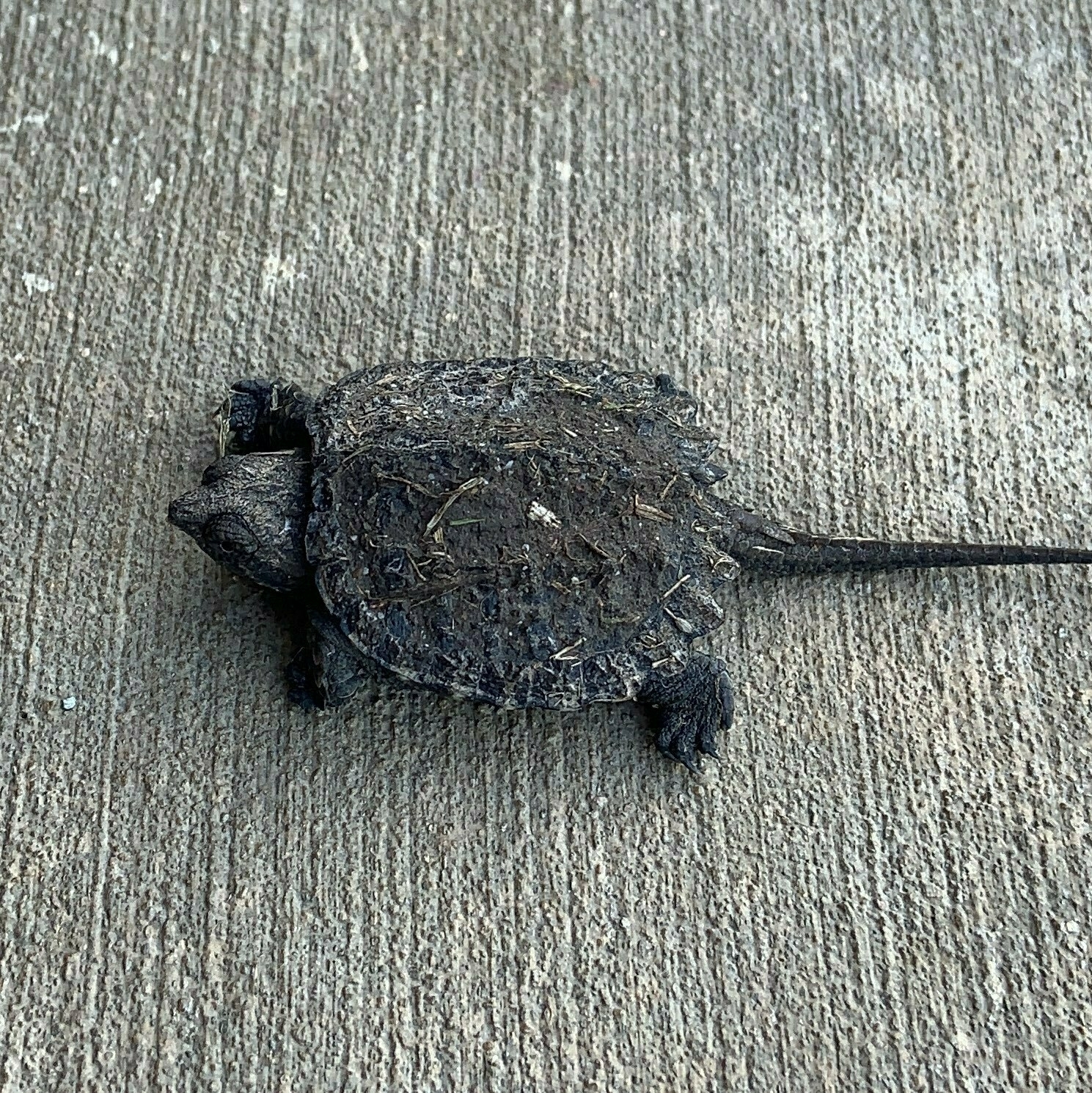
We just found a baby snapping turtle on our back patio. This was a surprise, since there aren’t any rivers or lakes within small-turtle-schlepping distance. Maybe he was dropped by a bird. He’s safe in a bucket and will be trundled to the river a few miles away.
Still chewing on discernment, and found this great essay by Sister Benedicta Ward which was very, very helpful. Discernment, as I originally thought, is closely related to prudence, though it would seem to be immediately prior to it. If prudence helps us to make the right decision, at the right time, and for the right reasons, discernment serves to first seek out the will of God. We can only do this if we escape the trap of mistaking our own will for His; this in turn requires first emptying the self. In short, humility.
Sr. Benedicta:
This [humility] is a refusal to exercise the judgement which condemns others, that killing self-assertion that was the cause and result of the Fall and which continues to damage relationships with God and with others. This itch to condemn by our judgement can be transfigured into discernment which sees only the mercy and goodness of God in others. The way to allow this 'right judgement in all things' to be formed is through humility of heart which in practice involves a consistent refusal to exercise that self-assertion which forms hostile and negative judgements against the neighbour. The true 'judgement' of others which is discernment is the God's eye view, which is always positive: as the Cloud-author puts it, 'Not what thou art, nor what thou hast been seeth God with his merciful eyes but what thou wouldst be'.
Motes and beams, right? Echoes of St. Catherine of Siena, who wrote in The Dialogue
For you cast contempt on your neighbors when you pay attention to their ill will toward you rather than my will for them.
In other news, I've taken Twitter off my phone (again), and have taken the additional steps of blocking several of my reflexive go-to news sites at my workstation. I can't say I've left Twitter completely, though I've pared my following-list to exactly 100 accounts that cover mostly local information (government, weather, and so on) and a handful of other hams I've come to know online. Brands and personalities are gone. Ditto for what remains of my Instagram account: stripped down to family only and set to private. RSS feeds are again on the ascent for me, so that's going to be it for awhile. Hopefully forever.
Have you ever read something so carefully that it comes back to you while you're sleeping? This is happening now with Cassian. I take this to be a good thing, and have been ruminating on the following bits from the first two Conferences so far:
First, as I posted the other day, our disciplines, plans, vigils, and other actions should (indeed, must) take second place to the law of charity. Whatever good we sought in prayer will be far outweighed by the anger we experience if we're interrupted by the good and necessary things around us. Our plans for the day may come to nothing; we will still encounter the Risen Christ in the everyday moments, and the moments-between-moments that we hardly notice. This ought to go without saying, but how many times have I thrown down my breviary, angry because something interrupted my plan for the moment? And that something was a child? Or a request from my wife? The whole of The Law and the Prophets comes to two sentences; I would do well to remember them early and often.
Second, Abba Moses addresses the distractions and thoughts that come to use while at prayer. While we may not be able to control the thoughts that come into our heads, we can certainly control our reactions to them. We can also influence the things that come into our heads by controlling what surrounds us the rest of the time, when we're not at prayer. The impact of this on our social media diets should be fairly obvious. In case it's not, here's my hot-take: social media is a raging trash fire. The less you use it, the happier you will be.
I'm still chewing on the meaning of discretion in the second conference. I had initially thought it was synonymous with prudence. I don't think that's the case and need to do some more reading and thinking. It seems to be closer to discernment. We could all do with more discernment.
From the first Conference of John Cassian, In a meeting with Abba Moses, the Abba says
…If perchance we are unable to carry out some strict obligation of ours because we are prevented by some good and necessary business, we should not fall into sadness or anger or indignation, which we would have intended to drive out by doing what we omitted. For what is gained by fasting is less than what is spent on anger, and the fruit that is obtained from reading is not so great as the loss that is incurred by contempt of one’s brother.
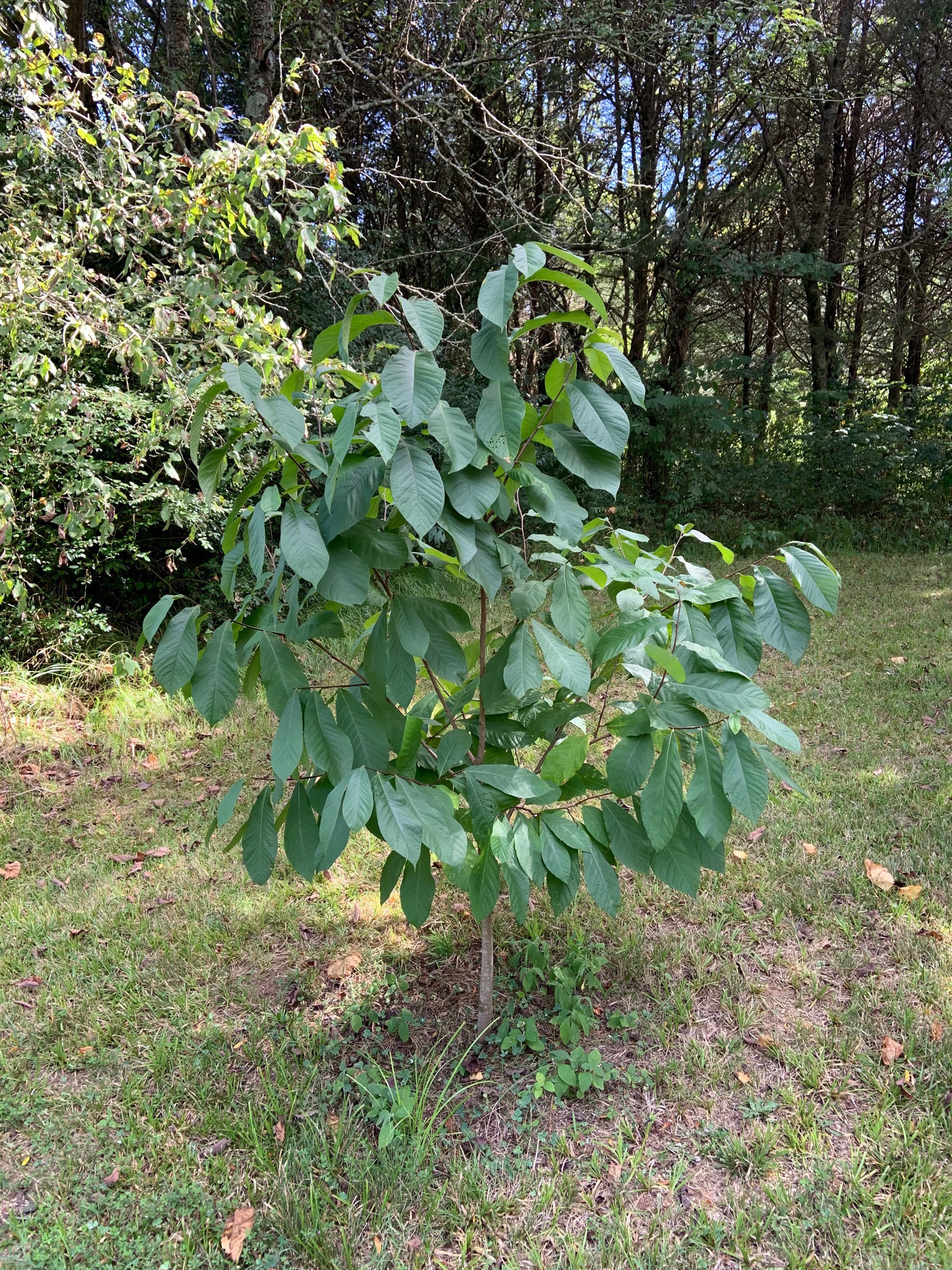
Have you ever seen a pawpaw tree? Now you have. Pawpaws are a fruit tree native to North America and were fairly well-known a generation or so ago. The fruit doesn’t keep for long after it’s picked, so they’ve never been much of a commercial crop. I’ve heard that pawpaws sometimes show up at farmer’s markets. We planted this one a couple of years ago and it seems to be doing pretty well - it’s nearly as tall as I am. Hopefully it will fruit in a year or so but I may need to add a second one. Its principal pollinators are flies, so the blossoms are described as a bit on the stinky side. This one is planted well away from the house.
The fruit is said to be delicious - a cross between mango and banana, with a creamy custard-like texture.
Seek: for identifying (via live camera or still photos) of insects, birds, spiders, reptiles, amphibians, plants, fungi, and anything else you might find in your yard or on a hike. The regular challenges are fun too. Every person I've introduced to this app has gone completely gonzo. Remember how much of a blast PokemonGo! was a few years ago? This is just like that, except with real things all around you.
Skyview: I paid a couple of bucks for the full version, and use this at night for ID'ing stars, planets, and satellites.
Merlin Bird ID: By the Cornell Ornithology folks, you answer a few questions about a bird you saw (size? colors? what was it doing?) and it makes a pretty good guess of what it was. The same lab publishes a beta app for Android that identifies specific bird calls via microphone. My brother showed me this and I nearly jumped from iOS.
Theodolite: Camera/ARG app for measuring angles, bearing, distance. I use this when I'm eyeballing distant thunderheads and matching them up with I can see on the weather radar websites.
BlitzortungLive: Blitzortung is a crowdsourced global lightning detector. Volunteers run the pi-based detector hardware and strikes are immediately triangulated and put on a map. The live app updates pretty quickly, but sometimes there's a few seconds of lag between a bolt you see and its appearance on the map.
Runner-up: Rockd, which tells you all about the geology you're standing on.
I have since finished Love in the Ruins and The Thanatos Syndrome. They were great. Love in the Ruins is an interesting product of its time - an end-of-the-world novel written in 1971 that's set somewhere in the imagined 1980s. It holds up pretty well to be honest, with a sort of semi-dark hilarity that's definitely reminiscent of contemporary movies and TV shows - think M*A*S*H (the movie). The political predictions alone will make it worth revisiting. Maybe certain predictions didn't land as well as jokes because, lo, they've basically come to pass.
The Thanatos Syndrome is a sequel inasmuch as it features the same main character (and several others) but it stands on its own and you needn't have read the other book first to enjoy it. I remember reading it, probably in college, based on the title and general conspiracy-plot description. The Catholic elements completely escaped me at the time, so it was well-worth revisiting. Have re-tackled the adventures of Dr. Tom More, Louisiana psychiatrist and self-described terrible Catholic, I'm probably going to add The Moviegoer and Lost in the Cosmos to the bookshelf soon.
As it is, I'm done with my fiction break and diving back into spiritual reading: The Conferences of John Cassian. I bought a copy of it on Amazon only to find out afterward that it's a selection of nine conferences and not the complete set. The introductory material is terrific, though, so I'm reading it while waiting for a full edition to arrive. And it will arrive just in time - we're about to hit the road for a funeral in the Ozarks and some meaty reading will be an extremely welcome distraction.
I seem to keep gravitating to the mystics and monastics - Bernard of Clairvaux and before that, Catherine of Siena. The Rule of St. Benedict. The Daily Office. What has this quarantine been but a sort of monastic enclosure of circumstance, where we live in community, occasionally receive guests, pray, and go about our daily work? Where we meet God in the ordinary moments of the day, in those others before us, and reflected in created beauty? Where, if we are honest, we fail, and seek the grace to rise again, and hasten along the path? Where we listen?
So I migrated over from github’s pages, which meant I had all of my old markdown posts stored locally. I had asked the micro.blog support folks about migration awhile back and was directed to a nifty little import script which used nodejs. But lo, in the meanwhile, an import button had showed up!
I still needed to insert the date into the frontmatter. My old posts had the date pre-pended to the filename (ie, 2020-01-08-some-title-here.markdown), so after bashing (har) my head against the wall for awhile, I came up with this, which cuts the leading date fields off the file and jams it into place at line 3. Hooray for Unix.
for i in `ls *.markdown`
do
sed -i "3a\date: `ls $i | cut -d- -f1,2,3`" $i
done
So I went from this at the top of every post:
---
layout: post
title: June Update
---
to this, which was slurped in beautifully:
---
layout: post
title: June Update
date: 2020-07-02
---
Yes, there are other ways to do this. Go nuts. This worked for me. I zipped everything up afterward and had all my old posts moved over lickety-split.
Cicada
I just finished Paul Elie’s The Life You Save May Be Your Own, which traces
the respective biographies of Flannery O’Connor, Thomas Merton, Dorothy Day, and
Walker Percy into a beautiful and engaging story of a particular moment in
American Catholicism. Merton and Day’s stories I already knew, having read The
Seven Storey Mountain and The Long Loneliness some time ago. O’Connor I knew
from studying Southern Lit in college and working my way through her complete
short stories, collected letters (Habit of Being, published posthumously), and
Wise Blood. Percy I knew only sort of obliquely. I read The Thanatos
Symdrome in high school or maybe college, intrigued by the general plot but
missing buy a country mile any sort of religious threads. I should probably
add it to the on-deck list along with Love In The Ruins.
As it is, I’ve got The Violent Bear It Away and the selected writings of St. Bernard of Clairvaux on the way. Also a guide on identifying wild edible plants, which has become sort of interest of mine recently. Off the top of my head, I can think of the following things growing in and around our yard which are said to be edible if not actually tasty: prickly pear cactus, red mulberry, blackberries, American persimmons (male trees which will not fruit), Passionflower vines, elderberries, and (if you can get them before every bird) black cherries. There’s plenty of wood sorrel and I’d wager purslane somewhere if I knew what it looked like.
I woke up with some terrible stomach cramps today. They seem to be on the way out, but it’s telling that in trying to figure out their cause, my wife looked at me archly and asked whether or not I had eaten anything I’d had found in the yard. The answer was no, if you were wondering.
So - we’ve had a fair amount of rain lately and the gardens are growing like crazy. The peppers look very promising and, mirabilis dictu, we’re keeping up with the zucchini production. I’ve been meaning to get some pumpkin hills planted so that we might have pumpkins by October. Maybe over the holiday weekend. As it is, we’ll be well-supplied with weird gourds. Several from last year were thrown into the compost heap and they’ve grown like Audrey III. I don’t think we can eat them or do anything but look at them, but they’re growing so well I don’t have the heart to pull them up.
RCIA-wise, I have taken over the neophyte year meetings, which we’ve been doing over Zoom. We do them monthly; the next session is coming up and I need to start preparing for a discussion on prayer.
I recently ‘attended’ an online symposium marking the fifth anniversary of Pope Francis' Laudato Si. I wasn’t really sure what to expect, but I enjoyed the discussion and would definitely watch more of that sort of thing in the future. Zoom-fatigue notwithstanding, registration and attendance were basically frictionless. I watched it on the back porch. It doesn’t get a whole lot easier than that.
One of the speakers was author Paul Elie, and somehow his book The Life You Save May Be Your Own came up. I can’t recall if it was mentioned, or if I saw it while pulling up other links during the discussion. In any event, I was intrigued: here was a book featuring Flannery O’Connor, Thomas Merton, Dorothy Day, and Walker Percy. How on earth was it possible that I hadn’t heard of it? Straight to the one-click-order screen. I had intended to wait until finishing The Dialogue but the weather was so nice on Memorial Day that I simply couldn’t resist. So far it’s wonderful. Elie weaves the stories of these four together into a sort of larger story of pilgrimage, of Catholicism with a peculiarly American savor. Among other things, it’s made me want to read more of Percy’s work. I read The Thanatos Syndrome years and years ago, but only remember bits and pieces of it.
Public celebration of Mass has resumed here, and we were able to receive several of our RCIA students last Sunday, God be praised. A few more will be received this weekend. After that we’ll start semi-regular (online) meetings for their neophyte year. This will be my particular focus and I’ve been putting some thoughts together on topics for presentation and discussion. My hope and intent is for these sessions to be more about praxis - the active life animated by faith and belief - rather than a guided tour of neato Catholic tidbits or a collection of stuff we never got to during Lent. Things like the methods and reasons for prayer, the colossal treasury of devotions, where to find answers, realizing a vocation, the interior life and so on. “Further up and further in,” as they said in The Last Battle. It’s a lot to bite off, but then again there’s no lack of time and space. The timing is good for something like this.
It’s been awhile since I posted any sort of update, so here we are. After finishing Cardinal Sarah’s Silence, I started The Day is Now Far Spent. I got about 100 pages in and stopped. It’s not really my bag, and I’m not sure how much shelf-life it will have, as it seems (so far) very much a response to a particular time and place. I can take a few guesses as to who the intended audience of this book is, and I’m pretty sure it’s not me.
By way of a break from spiritual reading, I found myself re-reading Nostromo by Joseph Conrad and obsessing, in a minor way, about its imaginary setting. What would modern Sulaco be like? A second- or third-tier cruise ship destination? Super exclusive, with a few casinos and high-end clubs? I dreamed up vintage Pan Am posters advertising Clipper service to Costaguana and tried to find maps of the country to see if they squared with my mental reckoning of the place. Spoiler: I couldn’t find any, and it is believed that Conrad didn’t have one either, owing to certain inconsistencies in his descriptions of place and distance. This seems to be born out by some articles I found on JSTOR. Colombia seems to be the likeliest inspiration.
I don’t know why the invented country has grabbed me like it has. Maybe it’s almost real in a way that, say, Middle Earth isn’t. The verisimilitude is dinged a little bit for me with some of Conrad’s Spanish, which feels clumsy and inauthentic, like someone who’s writing about a place he’s only read about. But those Pan Am posters…I would 100% buy one if I could find it. I can see them in my head so clearly that maybe I’ll find a way to create them myself.
Then April ended, and with it we celebrated the Feast of Saint Catherine of Siena, mystic, Dominican tertiary, and Doctor of the Church. She holds a special place for us; my wife was received (and I was re-received) at a parish named for her (before winding up at a church named for yet another a Dominican tertiary). Even so, I hadn’t read any of her work and all the quotes showing up on Catholic twitter inspired me to pick up The Dialogue, which I’m working through very slowly. So far, so good.
In other news: the formation program for the diaconate is on pause for a year because of the pandemic. Public Mass may be starting up again soon, which is wonderful. The weather has gone all haywire. After one late frost which killed my vegetable seedlings and pummeled my fig, we’re due for another one tonight, which means I’ll be out covering everything up (again) and hoping for the best. This would be the latest freeze ever recorded here, breaking a 90-year old record.