Mid Iuly
Then came hot Iuly boyling like to fire,
That all his garments he had cast away:
Vpon a Lyon raging yet with ire
He boldly rode and made him to obay:
— Spenser
The weather has settled into a warm, wet pattern that has the grass growing like crazy and the daily coin toss of another afternoon thunderstorm. Not quite boyling like to fire but we have plenty of runway left for hot weather.
I don’t mind it too much, but now that we’ve passed the Fourth of July, all eyes reluctantly begin turning towards the return to school. My wife is itching to get back into her classroom and set some furniture up. Kids are stocking up on supplies, and we’re preparing to move one of our daughters to the northeast for graduate studies. Beyond that, deeper into the fall, one of our sons is getting married. Another is moving out to be closer to campus. Our total headcount in the household will drop pretty dramatically by year-end. As close to empty-nest as we’ll be for a while. But not too fast, my Lord, not too fast.
In other words, we’re slowly cresting the hill of the 2026 roller coaster and are about to be full-speed ahead. I have found myself juggling three separate calendars: home, work, and parish. I can combine home and parish into a single view, but can’t include work because of security policies. It still means I have to look in two different places to account for my time, which has been short lately: our pastor has been on vacation, and I’ve been filling in all over the place. I’ll be grateful for a return to the normal cadence of things.
In the meantime, I’m “off” from parish work today. Tomorrow I will expose The Blessed Sacrament for a holy hour and follow it up with Liturgy of the Word + Communion. Several people have asked me to bless and invest them with the Brown Scapular. I wasn’t sure if I could, but apparently I can, so I’ll add that to the list for tomorrow. I’m also preaching this weekend and - mirabilis dictu - my homily is more or less done, though I’m still mulling over some of the phrases and sentences I’ll need in Spanish.
Proust has hit a pause for the moment; I haven’t had much evening time for reading since I’ve been prepping for the near-daily liturgical stuff instead. I’m still in the early section of Sodom and Gomorrah and taking tiny bites when I can. I’ve got some travel next week for work and can probably make some headway during the flights.

Proust-posting 2
Can ChatGPT Produce a Version of Proust Worth Reading? Bryan Charles wades into the world of computer-assisted translation.
…I was immersed in my Proust studies, comparing the different translations, reading the Oxford version as each volume came out. And while not a daily consideration, it is true that I saw the world I was lost in, the historical periods of the novel, of course, but also the very act of reading it, savoring sentences that demanded one’s full attention, that could not be raced through, and the encyclopedic information many of the dense paragraphs contained—I believed all of this to be, apropos of the novel’s themes, occurring outside of time somehow, untouched by contemporary grotesqueries, the imperatives toward automated summary and speed. I had interviewed Charlotte Mandell, whose translation of volume two of the Oxford Proust, In the Shadow of Girls in Blossom, moved me greatly, and asked if she felt threatened by machine translation. She did not. “No AI thing will ever be able to translate Proust,” she said.
And now an AI thing—or, I guess, multiple AI things under the rubric of a frictionless, all-in-one “translator’s assistant”—had helped to translate Proust.
With a paternal heart
Pope Leo XIV, in a letter to the Superior General of the FSPX:
In this spirit, and filled with Christian affection, I plead with you and ask you with all my heart: please turn back! I urge you to consider carefully the spiritual good of the faithful, because the schismatic act you are about to undertake would deprive them of the licit and, in some cases, even valid reception of the Sacraments, which they love and seek for their sanctification.
In short: do not do this, please. Contrary to the phrasing in media reports, the penalty for illicitly ordaining a bishop is attached to the very act itself, automatically. No one will be excommunicated for this; they will excommunicate themselves by the simple act of doing it.
You don’t need to be a canonist to read the law, which states as plainly as possible:
Canon 1387. Both the Bishop who, without a pontifical mandate, consecrates a person a Bishop, and the one who receives the consecration from him, incur a latae sententiae excommunication reserved to the Apostolic See.
No nuance or emanating penumbras. Even a deacon can understand it.
The practical value of the humanities
Dr. N. Ángel Pinillos defends the humanities, perhaps in the only way that really matters:
You will, at some point, need to advocate for your child at her school. You will need to read a teacher’s email carefully enough to notice what it is and is not saying, and write a response that is firm without being inflammatory, and recognize when an administrator is performing concern rather than offering it. You will need to talk to a doctor about a parent’s care, or your own, and follow an argument about risk and tradeoff that the doctor is making quickly and imperfectly, and ask the question that exposes the assumption the doctor has not examined. You will need to understand the context of someone who grew up in a place very different from you, with radically different values and experiences. You will need to read a contract. You will need to read a ballot measure. You will need to argue, in public or in private, for the candidate or the policy you believe in, and you will need to do this against people who are themselves trained, motivated and may not have your best interest at heart.
These are not the higher reaches of the soul. They are not transcendental encounters with truth and beauty. They are ordinary citizenship and ordinary parenthood and ordinary adulthood, and they have material consequences — for your kid, for your parent, for your community, for the decisions that get made about you when you are not in the room. The humanities prepare you for this. Not uniquely, not perfectly, but better than anything else in the curriculum does.
His points about the use of AI are, I think, spot on. Years ago, when Google was still something new, a cultivated understanding of how to find things in Google was something like a super-power. Knowing how to tune a search string, add booleans, or otherwise narrow the scope made all the difference between endless pages of clutter or the exact thing you were looking for. Thanks to SEO, this has become something a lost art, like scrimshaw.
Careful engagement with an LLM feels like a similar sort of thing now, except more so.
Illum oportet crescere, me autem minui
Joseph Cardinal Ratzinger (Pope Benedict XVI), writing in The Spirit of the Liturgy:
The fact that the dates of the Lord’s conception and birth originally had a cosmic significance means that Christians can take on the challenge of the sun cult and incorporate it positively into the theology of the Christmas feast. There are magnificent texts in the writings of the Fathers that express this synthesis. For example, St. Jerome in a Christmas sermon says this: “Even creation approves our preaching. The universe itself bears witness to the truth of our words. Up to this day the dark days increase, but from this day the darkness decreases…The light advances, while the night retreats.” Likewise, St. Augustine, preaching at Christmas to his flock at Hippo: “Brethren let us rejoice. The heathen, too, may still make merry, for this day consecrates for us, not the visible sun, but the sun’s invisible Creator.” Again and again, the Fathers take up the verse about the sun that we have already quoted from Psalm 18(19). For the early Church, this became a real Christmas psalm: the sun, that is, Christ, is like a bridegroom coming forth from his chamber. An echo of the Marian mystery was also heard in this psalm, which was interpreted as a prophecy of Christ. Between the two dates of March 25 and December 25, comes the feast of the Forerunner, St. John the Baptist, on June 24 at the time of the summer solstice. The link between the dates can now be sen as a liturgical and cosmic expression of the Baptist’s words: “He [Christ] must increase, but I must decrease” (Jn 3:30). The birthday of St. John the Baptist takes place on the date when the days begin to shorten, just as the birthday of Christ takes place when they begin again to lengthen.
I had only just re-joined the Church when I started asking about the diaconate. I met with a priest who wisely suggested that I take some time to mature in my newfound faith and instead devote myself to study for a while. This seemed like pretty good advice, and one of the things I did was address some gaps in my reading. I started college wanting to become a scientist, but Chemistry II cured me of that, so I switched to English Literature, intending to teach. I eventually landed in the journalism school, though I never went into the field. We got married right after I graduated, I took an office job, and never looked back.
Well, not often anyway. Beyond early coursework in British Romantic and Southern lit, I missed most - OK, nearly all - of the Great Books, so I set out to fix that over several years. My main list was Mortimer Adler’s, and between the library and the used book stores in my area, I got through most of them. I spent a lot of time reading the Classics, and still associate some of them - Plotinus in particular - with the bus ride to the office. I had switched to mass transit for a while and found myself with about two solid hours a day, which lined up perfectly with this effort.
Familiarity with the Western canon accomplished a few things. First, it let me in on other conversations and writing where I had previously felt at sea. References and parallels were lost on me before, but now I ‘got it.’ I felt like I had a seat at the table. Second, and this should go without saying, but it probably doesn’t: these books are classics for a reason, and the reason is frequently that they are great reads and more fun than I had anticipated. Yes, some of them were something of a slog (looking at you, John Calvin), but others had me thinking “holy mackerel how I have missed this?”
But most subtly, a deep re-immersion in poetry had me noticing the natural world around me with new eyes, and the movements of the sun and moon in particular - the color of afternoon light in late summer or mid-winter. There were some days that I felt like I was seeing these things for the first time. The heavens, indeed, proclaim the glory of the Lord, as do the shadows tracing across the yard throughout the day.
Trouble, with a capital T and that rhymes with P
My apologies in advance for the lack of any further Music Man references.
Jeremiah’s tables have turned and he’s trapped on all sides. His friends have betrayed him and everyone’s watching and waiting for his downfall. The Psalmist takes us further into the darkness: I have become an outcast to my brothers. Our Lord prepares his followers for the difficulties that are certain to come as they begin their apostolates and the work of public discipleship. Don’t worry, He says, about the hardships ahead. You know, the kind that can kill the body. Fear instead the one who can destroy both body and soul.
You know, if I were invited to a friends house for dinner and, upon arriving, the friend met me outside and said “Do not be afraid of all the spiders in the house,” I would probably still go in, because this is my friend. I would also be certainly completely occupied by the thoughts of spiders waiting for me. I would try not to be bothered, but honestly, this lands squarely in “don’t think of a polar bear” territory. The trick is getting past it.
Our lives will always have problems, pain and suffering. We don’t do things that we should, and do the things that we don’t want, as St. Paul says. Sometimes we feel isolated and alone – even among those who are closest to us. We sin, repent, and try harder and sometimes the world continues to feel difficult. It would be lovely if baptism removed not only sin, but problems. It would be fantastic if confirmation included a guarantee of constant success in life. The Christian life is not about the passing things of this life, but rather about the permanent things to come.
We age, change, suffer, get sick. As for death, it entered the world as a consequence of sin. But even this consequence has been reversed by Jesus Christ. As Paul says - the gift is not like the transgression What we received is far greater than what we lost – remember at Easter, when we praised “the happy fault” which won for us so great a Savior!
So how do I get past the spiders? By remembering that the soul is immortal - We tend to think about the soul as something abstract – something we need to sort of take care of for the future. Like luggage. We put it in the closet and pull it out every so often when we need it. But the soul is what makes us alive. Death is what happens when the soul separates from the body.
Whatever can happen to the body here on Earth during life – nothing can damage the soul. Nor can any pleasure or power make the soul any greater: it is the part of us that is eternal. We are neither a body running on autopilot, or a spirit trapped in a cage: the human being is both, made for two worlds at once. We can only stain it, or turn it away from God. This is a great comfort, and also more than a little sobering. We’re stuck with ourselves in a very real sense.
If we turn out eyes outward, we may be startled into noticing something. You were made for eternity. So is everyone else.
Evelyn Waugh - who wrote one of my favorite books - was taken to task by the interviewer once: You don’t hold a very high opinion of ‘the man in the street’ in your books.
Waugh responded that ‘the man in the streets’ is a modern myth, that there is no such thing. There are only men, he said, individuals and each with an immortal soul. From time to time, these creatures have need to use the street.
We are frequently tempted to see others as groups – faceless, nameless, soulless. This has always been part of our modern world, but is even more of a problem now when we reduce people to words on a screen. This easy when we are angry, and reflexive when we are nervous or anxious, but always wrong because each person you meet or ever will meet has an immortal soul too, also called to eternal life with God. To reduce another to a mere member of a group, with nothing else to commend them to the world is to ignore this immortal, eternal reality.
Each of us is counted by the Father and precious in His eyes. Each of us is unique and exactly what He loved when He loved us into being, creating us for eternity. Fear no one. Do not be afraid of anything in this life – we were made for what is on the other side of it.
Postscript: I feel obliged to point out that after several references to spiders in my homily I came home after Mass to find several spiders in our bathroom. My next homily will be featuring big piles of money.
A modern myth
I am scheduled to preach this weekend, the 12th Sunday of Ordinary Time. I also get to witness another wedding, which will be nice. I used my AI-assistant to assemble the preparatory notes on the readings - history, commentary, and so on - and it was…only marginally useful. Some of the bits on Jeremiah’s context were useful and perhaps informed a single phrase I’ll use, but that was about it. The real insights came during lectio and meditation. I’ll probably still use it occasionally; never know what little nuggets might turn up.
For the wedding, the homily will be brief:
- Marriage is modeled on the Cross because
- As Christ died on the Cross to save humanity, so you are both called to die to self for the other so that
- Your spouse becomes a saint
The rest is contained in the Exhortation before Marriage, which gets read prior to start of the liturgy.
As for Sunday, my homily’s kernel is captured in this quote which appears in Sykes' biography of Evelyn Waugh:
‘You have not much sympathy with the man in the street, have you, Mr Waugh?’ [Waugh answered that]…‘you must understand…that the man in the street does not exist. He is a modern myth. There are individual men and women, each one of whom has an individual and immortal soul, and such beings need to use streets time to time.’
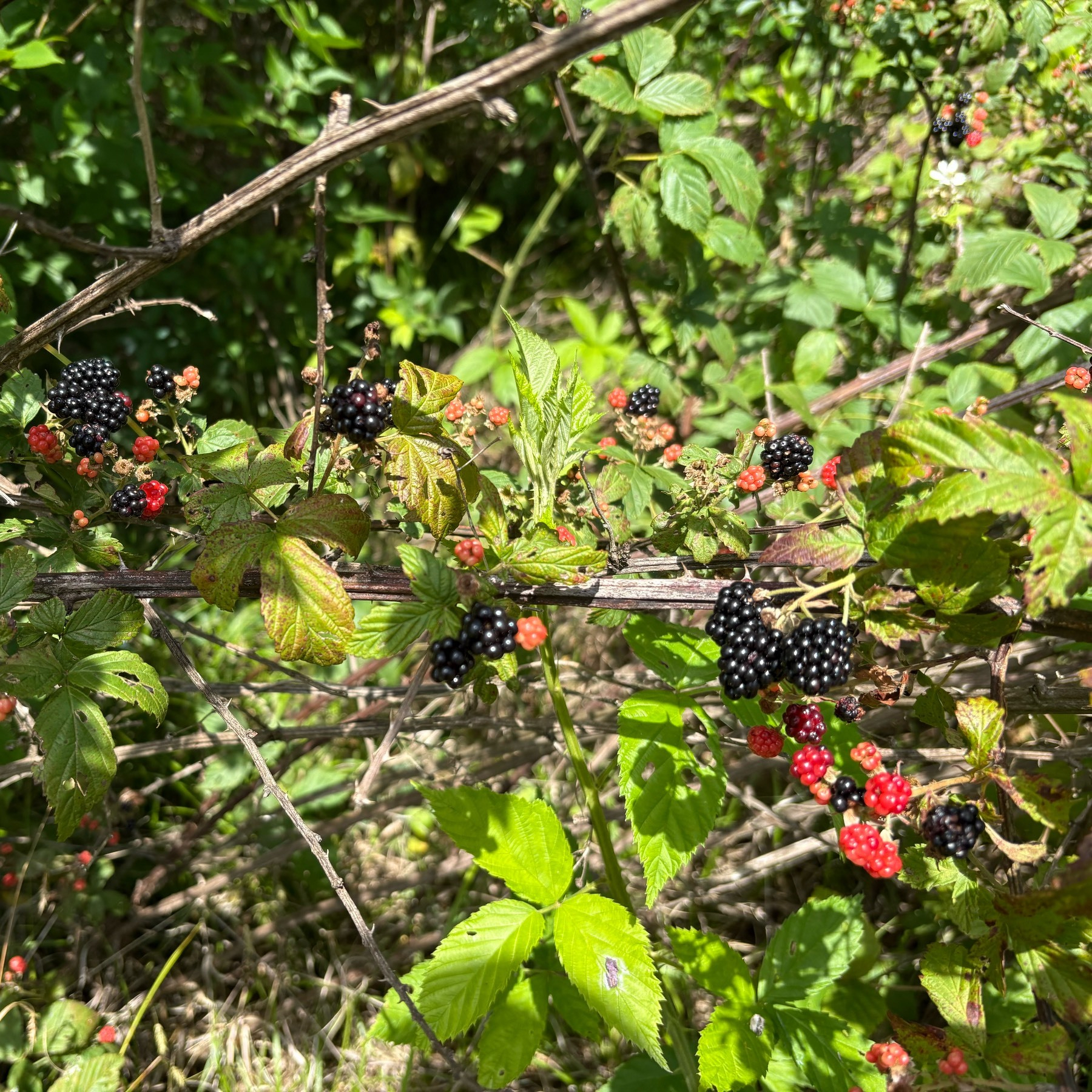
Wild blackberries are doing very well this year. I don’t think over ever seen so many fat ripe ones all at once before. I love these because they just grow everywhere and I don’t have to do anything but pick them and occasionally mow them down if they try to escape the margins.
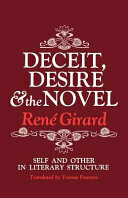
Currently reading: Deceit, Desire, and the Novel by René Girard 📚
“They say to understand it, you have to go back and do it again”
Nic Rowan writes about historian Gordon Wood and his decision to read Proust at 90 (h/t Arts & Letters Daily):
“We have a room full of bibliophiles here,” Will said, gesturing to the two hundred or so people seated in the ballroom. “What have you read recently in American history that we ought to read?”
“What book am I reading?” Wood asked.
Will nodded. “What book in American history?”
“I’m not reading American history right now,” Wood laughed. “I just finished Proust! I said I would do it before I die, and well . . .”
The whole room laughed. Wood was beaming.
My favorite bit is this:
The next morning I emailed him. Would he be interested in writing on reading Proust at ninety for The Lamp? His refusal was prompt, polite, but firm. He told me that this project was too “personal” for him to write about for a magazine audience.
I am not 90, but I get it. Something struck me about a particular scene recently and it tickled my brain for a bit before I realized I was seeing Girard’s triangular desire at work in one of The Narrator’s infatuations, so now I’m waiting for Deceit, Desire and the Novel to arrive.
Proust posting
The world according to The Narrator.
So there are the things we desire, except that it turns out that what we’re really after is our own mental versions of those things. We spin up these entire elaborate fantasies about a person, place, or thing and invest everything into them until they take on a life of their own within us. Then we meet the reality, and it’s not very much at all like we were expecting. It turns out that the real person, place, or thing, has a entirely different kind of thickness to it: a history, an interior life which is largely hidden at first but occasionally makes itself known in glimpses and hints.
The Narrator is constantly struggling with this gap between mental construct and reality, between an intense aesthetic ideal and the concrete. This gap, it turns out, drives him bananas. The breakdown between what he desires and what he’s forced to confront, whether its finally visiting a church in a beach town or a girl that he’s convinced himself is equally in love with him, begins to fill him with feelings of jealousy, obsession, mis-read signals and boatloads of angst (adolescent for the most part so far). Timeless stuff, in other words. Except for the social world, which I occasionally have to decode with a bit of digression and research (the demimonde, for example), the basic outlines of the books so far have been pretty universal. I don’t think I’ve ever read anything that puts me into someone else’s head as much as this.
Every contour of thought, the mind circling back after going down some side-path, the flash of something which feels like a profound insight but later turns out to be complete nonsense, and the nonsensical moments which shed a brilliant bit of light on human nature - all of these swirl around in a sort of chaos which is nevertheless matched by the slow drumbeat of passing time. Real enough that I’d like to reach into the book and dope-slap the guy now and again. You nitwit. Why not just ask her plainly? What did you expect to happen?. But it’s his head and they’re his mistakes. That I’m here second-guessing the action as if it really happened (and maybe some of it did really happen) is part of the genius.
Yes, I’m aware of some of the interpretive approaches to these works, the transpositions, and so forth. My response is…I guess? Maybe? The only supplemental material I’m using so far is the introductory sections to each volume and occasional LLM queries about social context, setting, places, and so forth. Meeting the text on its own terms feels like more than enough. I’m getting situated enough now to pick up on some of the humor like the run-up to finally getting see the famous actress, followed by profound disappointment, but then followed by a complete reassessment based on other people’s opinions. Plus ça change. The Faubourg Saint-Germain would have loved Instagram, but most of their accounts would be private.
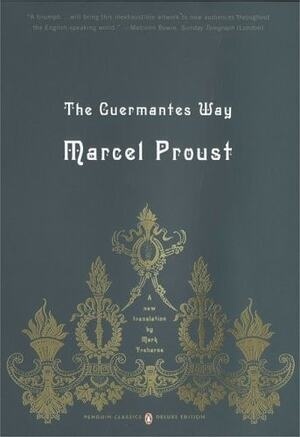
Currently reading: The Guermantes Way by Marcel Proust 📚

Sixty-six pounds of dog
And after her, came jolly June, arrayd
All in greene leaves, as he a Player were…
— Spenser, Cantos of Mutabilitie
The lads went to the vet today and are weighing in at 33 pounds apiece. This, we think, is closing in on their maximum weight as predicted by the breeder so things seem to be on track. Housebreaking is more or less on track; very few accidents any more. They’re occasionally getting up to mischief so they don’t have full run of the downstairs yet. Right now they’re sacked out in their largish enclosure near the office after all the excitement of the outing.
The sun has finally come back out after several weeks of rain and overcast skies. It was a soothing indoors vibe and the garden certainly liked it, but it’s also nice to dry things out for awhile. My new favorite tool for the garden is a stirrup hoe, which I’ve been using to take care of the weeds. I can reach nearly the entire bed from the sidewalk and it makes short work of anything growing where I don’t want it. The rest of the ongoing work is just looking at, which I do several times a day, and bits of grooming here and there. The tomatoes are going bananas and both of the superhot peppers are growing extremely well. No blossoms yet, but I don’t expect it will be much longer. Last night was cool, dry, and breezy, which made for a perfect bourbon-and-cigar session on the front porch.
Otherwise things are settling into their usual summer pace. Proust continues; still making my way through Vol 2. I’m committed to the story at this point so I plan to keep going.
Many martyrs this week: St. Justin, Saints Peter and Marcellinus, St. Charles Lawanga and companions and St. Boniface on Friday. Wearing a lot of red for the communion services. Thursday night we’ll do Exposition and Benediction, too. Next week I have a bit of business travel but all is well, and all will be well, and all manner of things will be well.
Magnifica Humanitas
Yesterday was about a nice a day off as I could have asked for: slept in a bit, coffee, read through Magnifica Humanitas, cleaned up and straightened out the office, did a bit of planting, and so on. I had put some pork butts in the smoker the night before, so when we pulled them out yesterday morning, dinner was already done. The rainy weather kept us inside for most of the day and things stayed kind of low-key.
Herewith are some of my favorite bits and pieces of Magnifica Humanitas. I am still meditating on it though I’ve already adjusted a few things personally - first and foremost that the tools are not as morally neutral as I had originally considered. This was one of those “duh” moments for me; built-in biases have been in the back of my head since I completed Cathy O’Neil’s Weapons of Math Destruction a few years back.
I also very much loved the Babel/Nehemiah analogy used throughout. Beautifully done. One thing I’ll be watching for is how the social doctrines of the Church land on folks who may be encountering them for the first time in this document. The setup goes on for nearly the first 100 paragraphs before digging into the matter at hand. This observation is key - anything more particular risks becoming outdated before the week is out.
- It is not possible to provide a single, comprehensive definition of AI. What can be stated, however, is that we must avoid the misconception of equating this type of “intelligence” with that of human beings. These systems merely imitate certain functions of human intelligence. In doing so, they often surpass human intelligence in speed and computational capacity, offering tangible benefits across many fields. Yet this power remains entirely tied to data processing. So-called artificial intelligences do not undergo experiences, do not possess a body, do not feel joy or pain, do not mature through relationships and do not know from within what love, work, friendship or responsibility mean. Nor do they have a moral conscience, since they do not judge good and evil, grasp the ultimate meaning of situations, or bear responsibility for consequences. They may imitate language, behavior and analytical skills, or even simulate empathy and understanding, but they do not understand what they produce, for they lack the affective, relational and spiritual perspective through which human beings grow in wisdom. Even when these tools are described as capable of “learning,” their way of doing so is different from that of a human person. It is not the experience of those who allow themselves to be shaped by life and grow over time through choices, mistakes, forgiveness and fidelity. Rather, it is a form of statistical adaptation based on data and feedback, which can be very effective, but does not imply inner growth.
[…]
- …The speed and simplicity with which information, complex analyses, media content and practical assistance can be accessed undoubtedly makes life easier. Yet they can also encourage excessive reliance and the search for ready-made answers, and weaken personal creativity and judgment. The apparent objectivity of the responses and suggestions these systems provide can lead us to overlook the fact that they reflect the cultural assumptions of those who designed and trained them, with all their strengths and limitations. The artificial imitation of positive human communication — words of advice, empathy, friendship and even love — can be engaging and at times genuinely helpful. However, for less discerning users, it can also be misleading, creating the illusion of a relationship with a real personal subject.
The built-in biases cannot be avoided, which leads to
…a simple but compelling consequence: we cannot consider AI to be morally neutral. In reality, every technical tool embodies choices and priorities through what it measures, ignores and optimizes, and how it classifies people and situations. If a system is designed or used in a way that treats some lives as less worthy, or excludes them without the possibility of appeal, then it is not merely a tool “to be used well,” since it has already introduced criteria that contradict the inalienable dignity of the human person. For this reason, ethical discernment cannot be limited to asking whether we are using a system for good or bad purposes; it must also examine how that system is designed and what vision of the human person and society is embedded in the data and models that guide it.
In paragraphs 115-130, the Holy Father takes on the latest re-brand of Gnosticism: the transhuman/post-human mindset which seeks to ‘upgrade’ humanity, promising an end to disease and death and an elimination of all suffering.
- From the perspective of the Church’s Social Doctrine, the key issue is not the use of technology as such, but the vision that underlies it. If the human being is treated as something to be perfected or surpassed, it becomes easier to accept that some lives are less useful, less desirable or less worthy. In the name of progress, “necessary sacrifices” may begin to be justified, placing the burden on the most vulnerable in pursuit of a supposed optimization of the species. In this regard, the aforementioned warning of Saint Paul VI retains great foresight: indeed, scientific and technological advances, when detached from moral and social progress, end up turning against humanity. For this reason, a clear distinction must be made. It is one thing to integrate technology within a human-centered, relational vision; it is quite another to be guided by an outlook that devalues human limits and promises a purely technical form of “salvation.”
As the Pope points out, “humanity flourishes not despite our limitations, but often through them.” We can - and should - work to alleviate suffering while we also acknowledge our limits, our finitude. Not surprisingly, the Holy Father frequently invokes the Two Cities.
There is much more to be studied here; these are the bits which jumped out at me.
Homily prep
Here is an AI prompt that I’ve been working on. It puts Claude to work as something of a research assistant when it’s time for me to prepare for a homily. As my weekends for preaching are scheduled well in advance, I have plenty of runway. Usually a week or two out, I’ll spend some time with the texts in lectio divina, listening for the guidance of the Holy Spirit. Sometimes this is sufficient; sometimes it isn’t.
When I need to dig a little deeper, I’ll start opening commentaries and doing some background work and this is designed to put some starting points in my hands. I created a project in Claude, and added a CSV export of my Zotero library, which I use to track my theology books. Then I added the following standing instructions, which we’ll look at a piece at a time.
First, the setup. This is what I’m after: main sections with a note about the user - me - of the final product. Bearing in mind that I will also be preaching in Spanish, pull out any important terms and give me their translations.
You are assisting a Catholic deacon with homily preparation. When given a liturgical date or a set of scripture readings, you will produce a structured homily preparation document which includes:
- EXEGETICAL NOTES — Brief critical notes on each reading (key Greek/Hebrew terms, literary form, historical context)
- PATRISTIC WITNESS — 1–2 relevant quotations or references from the Fathers on these texts (verify before citing; flag any uncertainty)
- MAGISTERIAL CONNECTIONS — Relevant CCC paragraphs, papal documents, or conciliar texts
- SPANISH GLOSSARY - include a list of key concepts and provide a list of their equivalents in Spanish suitable for a largely Mexican/Central American assembly.
Next, I want to be very specific about the sources that I want used. This is an important step because it’s possible the LLM will consult it’s own training data rather than conduct web searches for additional resources. The problem with the training data is that the LLM may also respond with inferences which might or might not be correct, and I want as much precision as possible. By instructing the LLM to use these sources I am forcing the issue. I also make a reference to my personal library.
Sources for searching:
- Vatican.va for magisterial documents
- USCCB.org for lectionary text confirmation
- New Advent (newadvent.org) for patristic sources
- The Catena Aurea at www.ecatholic2000.com/catena/
- Bible commentaries (note which and try wherever possible to use specifically Catholic commentators)
- The file called “theologicallibrary.csv” contains an inventory of physical texts available to me. Where relevant, recommend specific titles from this list. I also retain online access to the library of St. Meinrad Archabbey and can access additional resources such as the Catholic Encyclopedia.
This next part also clearly spells out what I do not want as well as other things that should restrict the results. Most important: I do not want any suggestions for themes, focus, structure, content, imagery, or applications. I want the academic facts and nothing else. There is also a note about the Spanish texts we use.
Constraints:
- Do not fabricate quotations; flag uncertainty explicitly
- Do not suggest a focus or theme; this is a task specifically reserved to the deacon.
- Use RSV-CE for scripture quotations
- When the deacon assists at Mass in Spanish, the pastor favors the use of lectionaries from his home country of Colombia and which do not match the Spanish readings at the USCCB. The Colombian Episcopal Conference (CECol) lectionary is published by San Pablo Ediciones and is based on the Biblia de Jerusalén in Spanish. It may differ from the USCCB Spanish lectionary, which draws on La Biblia Latinoamérica. The preacher should verify the specific wording of each pericope with the pastor before quoting from the Spanish readings.
- Note any Denzinger references where applicable
The last part is a set of specifications that I actually had the LLM generate - they have to do with the way I want the final document to look. Since I want a PDF, I want it to start with LaTeX. Since there are frequently other languages (Greek and Hebrew) in the output, I want those characters to render correctly. And since I am a nerd, I want it to look more like an academic text than a business document - keep the decorations and other visual clutter to a minimum. Just create a clean, readable document that will look good printed or on an iPad.
After several iterations over the final document I landed on one that I liked, so I told the LLM “give the instructions necessary to reproduce this last version precisely” and this is what it said:
Output Format — LaTeX/PDF:
- Produce both a compiled PDF and the .tex source file.
- Use XeLaTeX as the engine (xelatex), not pdflatex. XeLaTeX is required for Unicode Hebrew and Greek.
- Use FreeSerif as the main body font (available at /usr/share/fonts/truetype/freefont/). FreeSerif has confirmed Unicode coverage for Hebrew (U+0590–05FF) and polytonic Greek (U+0370–03FF). Specify all four faces explicitly in \setmainfont.
- For Greek, use the polyglossia package with \setotherlanguage[variant=ancient]{greek} and the \grk{…} command (or \textgreek{…}).
- For Hebrew, do not load polyglossia Hebrew or the bidi package — bidi.sty is not installed in this environment. Instead, render Hebrew inline via a direct \fontspec call to FreeSerif: \newcommand{\hbr}[1]{{\fontspec[Path=…]{FreeSerif}#1}}. Hebrew glyphs will display correctly in any modern PDF viewer; full RTL reordering is viewer-dependent.
- For tables, use longtable with \RaggedRight and p{…} column specifiers (requires the ragged2e package). Never use l, c, or r specifiers for columns containing substantial text — they cause overflow. Size columns to fit within the text width (default text width on letter paper with 1.25in margins is approximately 6in).
- Use mdframed for note boxes and scripture quotation blocks. Preferred style: left-bar only (topline=false, bottomline=false, rightline=false) with a light gray background for quotations; full box with gray border for notes/warnings.
- Section headings: titlesec with \Roman{section} numbering and a thin rule beneath in a muted gold/ochre color. Keep color use minimal and academic.
- Compile twice to resolve longtable page breaks and hyperref labels.
- The formatting should be academic and spare, not business-oriented. Avoid decorative color tables, gradient headers, or heavy visual elements.
The full prompt is here if you’d rather grab raw text.
When I want to use it, I open the project and say something like “Prepare a homily prep doc for the 12 Sunday of Ordinary Time, Year A - here is a link to the readings,” and then I paste in a link to the USCCB’s site. And off it goes.
Our pastor begins a pretty hectic travel schedule which puts me in the chute for a whole bunch of daily communion services. These are held, like daily mass, in the small chapel behind the main sanctuary, which is the original church building and has been combined with a small fellowship hall. The weekday crowds are small but very regular. Language alternates by day, English and Spanish, and we do Exposition and Benediction on Thursday evenings beforehand. Sometimes I preach, sometimes I don’t. Today was one of the days I didn’t. As our homiletic instructors told us, if you have nothing to say, don’t take ten minutes to say it.
In other news: I’m very eagerly awaiting for Magnifica Humanitas to drop. I’ve been mulling on this for awhile now and trying to figure out a way to properly assess AI personally, professionally, and pastorally. What I’ve gotten to so far is a series of questions for reflection on the use of AI for any particular task or outcome:
First, does this use supplement human judgment and prudence, or substitute for them? Will the person - for whom the work exists, and not the other way around - be freer from drudgery and tedium?
Second, does the pace of adoption allow for deliberation and the exercise of prudence?
Third, to whom do the benefits of this use accrue? Who bears the costs of this decision, even - or especially - if the costs are not necessarily reflected in a P&L statement?
These questions, I hope, distinguish between an outright rejection of AI, which seems unsustainable on the one hand, and wholesale, at-all-costs adoption on the other. By treating them as morally neutral tools, we consider whether or not their use contributes to human flourishing or risks deskilling, marginalization, or injury to agency.
Nothing new on the book front. Proust certainly does have a handle on adolescent romantic angst as experienced by someone who spends entirely too much time in his own head. Thinking back to early teens…yeah, pretty much nails it.

Currently reading: In the Shadow of Young Girls in Flower by Marcel Proust 📚
Select from among you…
This weekend I was offered the option of a funeral or a baptism, so I took the baptism which turned out to be eight baptisms and it was a blast. The main sanctuary was set up for a wedding at noon, so our parish witnessed the full arc of life: baptism, matrimony, and death. It’s continually humbling to be close to these moments of life.
Speaking of matrimony, my marriage prep group - four couples - wrapped up the final session last week. Nobody fled the room, so it looks like they’re all going through with it. They’ve all been great and I’m very much looking forward to seeing them plunge ahead into this new life together.
Elsewhere on campus, a ladies ministry ran one of their semi-regular food sales: from-scratch tacos and other assorted goodies. I have now tried lengua (tongue) tacos and they were delicious. 11/10, will be ordering again. Interest in the next OCIA program is beginning to grow - we’re getting more and more narthex conversations from people asking about the next session. We’ve got a meeting coming up to discuss next year; sussing out a place to meet will be high on the list.
Our pastor is about to start a slightly hectic spring and summer travel schedule which means I’ll be stepping in for daily communion services for awhile. I’m also penciled in to lead a May crowning at the end of the month, so that will be fun. Daily stuff means more preaching, so more at-bats. I like the daily homilies: short and to the point. My next scheduled weekend for preaching is Ascension Sunday, so I’ve got a bit of time to work on that one.
In my ongoing conversations with my cohort-mates (we have a groupchat, of course), I’m struck by how very different the directions our diaconates have taken, especially in the different vibes (for lack of a better word) at each of our parishes: very modern in one place, very traditional in others. Very rich in one place, very working-class in another. One of my favorite expressions about the Church is that it’s A Really Big Tent, but the mind sort of boggles over the scale of the Bigness. One thing we all share in common is that we’re busier than ten rats in a bag of Cheetohs.
Gardenwatch: things are doing well. The temperature has cooled off a bit and I think we’ve got some rain in the forecast this week which will be nice. I’ve got some business travel and will miss most of it.
Bookwatch: closing in on the end of Swann’s Way. I feel sort of invested now so I’ll probably continue to the next book, In the Shadow of Young Girls in Flower. I also coming close to the end of De Sales' Treatise, so it will be time to pick new spiritual reading before too much longer. About halfway through the Dicastery’s publication.
Dogwatch: still growin'. Training is highlighting some personality differences. One is very well motivated by food or treats of any kind; the other one is variable in his mood. What entices him today is boring tomorrow, that sort of thing. He keeps it interesting for sure.
Radiowatch: nothing at all, sad to say. Occasional tinkering with ADSB and ACARS but not much else. Radio tends to be a cold-weather hobby any more.
The Social Edge
Bright Simons points out that the miracle of an LLM is less a measure of its own ‘smartness’ and more a reflection of the civilization that produced it, because it’s the civilization’s output which trained it.
What all this implies for AI is straightforward. Every token in a training corpus is a fossil of social interaction—a trace of negotiation, argumentation, institutional meaning-making, or cultural transmission. The intelligence that AI systems exhibit was never individual to begin with. It was forged in the spaces between people.
And if those spaces are allowed to shrink due to over-dependence on human-machine interaction, we have trouble. If the interactions that generate rich language become rarer, shallower, or more homogeneous, then the intelligence that depends on them will slowly degrade. We will not hear any bangs, true, but we will notice a gentle, almost imperceptible narrowing over time. The machines to which we are fast entrusting the future of discovery will slow down when it matters most.
The more we cognitively offload to the LLM, the more our own competence erodes. We stop producing some of the higher-end tasks to the AI and so eventually we run out of stuff to feed it.
This intersects very nicely with Reclaiming Human Agency, mentioned below, reaching several of the same conclusions by purely secular paths.